
Developer tools & automotive
Motomarks.
One integration for automotive brand assets.
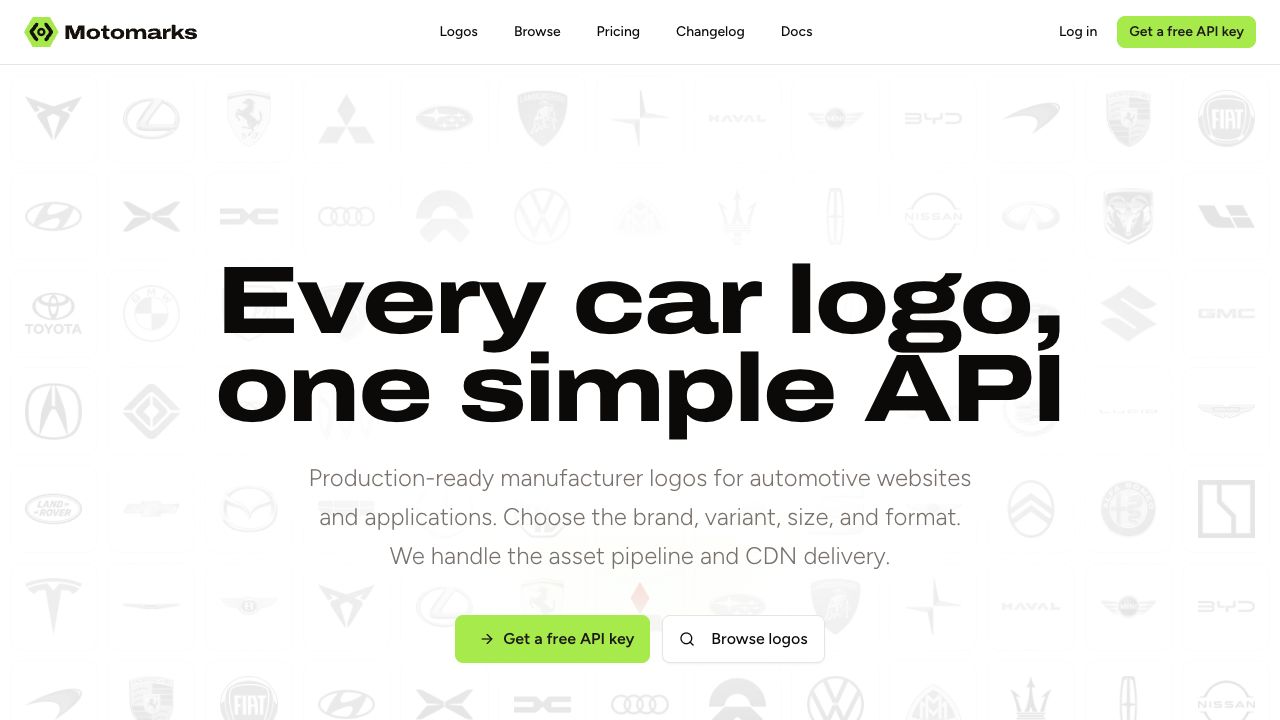 View project
 Adrian built Motomarks to take recurring logo maintenance out of automotive product development. It is another production application through which we practise and refine our in-house agent workflow.
The challenge
Automotive products need recognisable, consistent brand assets across many layouts. Searching for files, preparing variants and maintaining copies across repositories distracts teams from the product they are trying to build.
The approach
Motomarks treats the asset library as a service: a documented way to request the brand and output a product needs. We applied our in-house AI agent prompts and memories to the development process, using a focused developer problem as another setting for improving how we build production apps.
One request, different layouts
Developers can request full logos, badges or wordmarks where available, with PNG and WebP outputs and five preset sizes. Consistent URL parameters cover the brand, type, size, format and aspect.
More than image files
Brand search and structured metadata support integration. Publishable and secret API keys serve different contexts, while a dashboard provides key management and usage visibility.
Keeping the library useful
An AWS CloudFront-backed CDN delivers published assets. A public changelog records additions and updates, giving developers a way to follow the library as it evolves.
OUR APPS.
OUR PRACTICE.
Motomarks brings a different kind of precision to the workflow: the interface includes URLs, parameters and documentation as well as screens. Building a service for other developers helps us practise keeping the product promise consistent across those surfaces.
Across these apps, our in-house prompts give agents direction and our memories carry useful context forward. We use our own products to refine that approach, with the aim of developing production applications quickly and precisely.
Give the work a clear brief.
Start with the problem and the intended behaviour. A focused prompt gives an agent something concrete to work towards.
Carry the learning forward.
Agent memories keep useful context available between iterations, so each task can build on the thinking that came before.
Bring the workflow to your business.
Apply the same approach to a new product or an existing process. Production quality remains a design and engineering responsibility.
THE WORK,
UP CLOSE.
- Full-logo, badge and wordmark variants
- Predictable image URLs and CDN delivery
- Brand search and structured metadata
- API key management and usage visibility
- A public record of library updates
A focused developer service built around a recurring maintenance problem. The same approach can help other businesses identify repetitive work, define a useful product boundary and develop a production app with a reusable AI-assisted workflow.
BUILT BY ADRIAN CIASCHETTI. COVER: SCREENSHOT OF THE PUBLIC HOMEPAGE.